

This Post cover following topics
Introduction
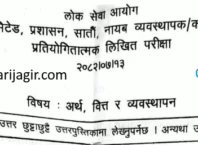
Preparing for the Public Service Commission (Lok Sewa Aayog) exams in Nepal requires a strategic approach, and nothing beats practicing with authentic old question paper. In this blog post, we have compiled the complete First Paper (Technical Subject and Management) from the open competitive written examination for the position of Assistant Manager (System) [प्राविधिक, सूचना प्रविधि, छैटौं, सहायक प्रबन्धक (सिष्टम)] under the Employees’ Provident Fund (Karmachari Sanchaya Kosh – कर्मचारी सञ्चय कोष). This exam was conducted on 2083/02/02
💡 Why Old Question Paper Matter
Studying section officer exam past questions gives you a real edge – understanding the marking scheme, Nepali/English bilingual format, and expected answer depth is crucial to scoring well.

EPF System 6th Old Question Paper, Karmachari Sanchaya Kosh System 2083, Lok Sewa Aayog Computer Engineer Questions, EPF Assistant Manager System Syllabus,
PSC IT Officer Question Paper, Nepal EPF Exam Questions, Software Engineering MCQs Lok Sewa, Electronic Transaction Act 2063 Questions
Exam Overview
Organized By: Public Service Commission (Lok Sewa Aayog), Nepal
Organization: Employees’ Provident Fund (Karmachari Sanchaya Kosh)
Position: Assistant Manager (System) / प्राविधिक, सूचना प्रविधि, छैटौं, सहायक प्रबन्धक (सिष्टम)
Paper: First Paper (Objective + Subjective)
Subject: Technical Subject and Management
Full Marks: 100 (Objective: 50 | Subjective: 50)
Total Time: 2 Hours 15 Minutes ( MCQ – 45 Min Subjective – 1 hour 30 Mintues)
Part 1: Multiple Choice Questions (Objective)
Time: 45 Minutes | Marks: 50
Note: Mentioning the Question Booklet KEY is mandatory on the answer sheet
Below are the 50 objective questions asked in the examination covering Core Computer Science, IT, and Software Architecture:
1. In the context of query optimization, which of the following techniques is used to improve performance?
A) Indexing
B) Data encryption
C) Data normalization
D) Query rewriting
2. Which model is best suited for projects with unclear requirements at the start?
A) Spiral
B) Waterfall
C) V
D) Big Bang
3. Which software testing technique involves testing individual units or components of a software application in isolation?
A) Integration testing
B) System testing
C) Unit testing
D) Acceptance testing
4. Verification is the process of:
A) building the right product
B) building the product correctly
C) selling the product
D) documenting the product
5. Which of the following is an example of a CASE tool used during the design phase of software development?
A) Debugger
B) Compiler
C) Data flow diagram tool
D) Version control system
6. The modification of the software to match changes in the ever-changing environment falls under which category of software maintenance?
A) Corrective
B) Adaptive
C) Perfective
D) Preventive
7. An Information System (IS) is used to:
A) only store data
B) replace human workers
C) support decision making and operations
D) design hardware
8. Which of the following is an example of explicit knowledge?
A) A worker’s intuition on customer behavior
B) A manager’s years of experience
C) Team collaboration in a meeting
D) A documented user manual
9. What is the purpose of XML?
A) Style web pages
B) Store and transport structured data
C) Replace HTML
D) Execute server-side scripts
10. What is the main security risk of using cookies for session management?
A) Stolen via XSS
B) More disk space
C) Browser slow
D) Hard deletion
We also Prepare these topics for you
- Other years of Computer Operator old questions
- Computer Operator MCQ practice sets
- Computer Operator practical exercises
- Computer Related post syllabus
- PSC IT Skill Test preparation guide
- Government Job Vancancy Notice
11. What is the main advantage of AJAX in web applications?
A) Faster hardware processing
B) Reloading the entire page
C) Asynchronous data exchange without full page reload
D) Secure database storage
12. The worst case occurs in a linear search algorithm when the item is:
A) somewhere in the middle of the array
B) not in the array at all
C) the last element in the array
D) the last element in the array or is not there at all
13. Which data structure is most suitable for implementing a priority queue?
A) Array
B) Linked List
C) Heap
D) Stack
14. Which notation represents the upper bound of an algorithm?
A) $\Theta$ (Theta)
B) $\Omega$ (Omega)
C) O (Big-O)
D) $\alpha$ (Alpha)
15. What is the primary disadvantage of DFS in infinite state spaces?
A) High memory consumption
B) Incompleteness
C) Slower execution
D) Requires heuristic function
16. What strategy does quick sort use to sort an array?
A) Greedy approach
B) Dynamic programming
C) Backtrack
D) Divide and conquer
17. Which type of learning uses labeled data?
A) Supervised Learning
B) Reinforcement Learning
C) Semi-supervised Learning
D) Unsupervised Learning
18. Which of the following statements is false about choosing a learning rate in gradient descent?
A) Small learning rate leads to slow convergence
B) Large learning rate causes the loss function to fluctuate around the minimum
C) Large learning rate can cause divergence
D) Small learning rate causes the training to progress very fast
19. Which AI technique is inspired by natural evolution?
A) Genetic Algorithms
B) Support Vector Machine
C) Decision Trees
D) Neural Networks
20. The proposition $(P \Rightarrow Q) \wedge (Q \Rightarrow P)$ is a:
A) tautology
B) contradiction
C) contingency
D) absurdity
21. How do you represent “All dogs have tails”?
A) $\forall x: dog(x) \rightarrow hastail(x)$
B) $\forall x,y: dog(x) \rightarrow hastail(y)$
C) $\forall x,y: dog(y) \rightarrow hastail(x)$
D) $\forall x: dog(x) \rightarrow has \rightarrow tail(x)$
22. In which of the following service models is the hardware virtualized in the cloud?
A) NaaS
B) PaaS
C) CaaS
D) IaaS
23. A hypervisor is used in virtualization to:
A) increase clock speed
B) manage multiple VMs
C) cool the CPU
D) enhance security
24. Edge computing processes data:
A) Central cloud
B) IoT devices
C) On cloud with low power
D) On paper
25. Big Data Analytics primarily deals with:
A) small datasets
B) structured data only
C) only numerical data
D) large, complex datasets
26. Which layer of an IoT architecture is primarily responsible for data processing and decision making?
A) Perception
B) Network
C) Application
D) Transport
27. Which architecture separates instruction and data memory?
A) Von Neumann
B) Harvard
C) RISC
D) Stack-based
28. In memory-mapped I/O, devices are treated as:
A) Part of memory address space
B) Separate from memory
C) CPU registers
D) Cache memory
29. Instruction-Level Parallelism (ILP) is primarily achieved through:
A) multi-core design
B) higher clock speed
C) 128-bit databuses
D) superscalar execution and pipelining
30. In a control unit, the excitation signals are primarily responsible for:
A) setting memory size
B) enabling or disabling control lines
C) managing cache policies
D) performing addition
Also prepare with
Computer Operator (31) First Paper (14) General Knowledge (14) Government Job (47) Kharidar (11) Lok Sewa Aayog (17) Nayab Subba (10) Nepal Bank Ltd. (9) Officer First Paper (7) Old Question (8) Old Questions (52) Province Public Service Commission (19) Public Service Commission (62) Rastriya Banijya Bank (9) Result (11) Section officer (35) Sifaris (7) Syllabus (25) Vacancy (71) Written Exam (48)
31. Which of the following best describes the instruction cycle?
A) Fetch Decode Execute
B) Execute Fetch Decode
C) Decode Execute Store
D) Fetch Execute Decode
32. In a real-time operating system:
A) process scheduling can be done only once
B) all processes have the same priority
C) kernel is not required
D) a task must be serviced by its deadline period
33. In Banker’s Algorithm, if the system is in an Unsafe State, this implies:
A) Deadlock has occurred
B) The CPU is idle
C) Deadlock is possible but not certain
D) RAM is full
34. A DMA controller transfers 1MB of data at 100MB/s, followed by 1ms interrupt overhead. What is the total transfer time?
A) 2ms
B) 9ms
C) 10ms
D) 11ms
35. Which of the following is not a function of the kernel in operating systems?
A) Process scheduling
B) Memory management
C) User authentication
D) File system management
36. In Round Robin scheduling, each process gets:
A) unlimited CPU time
B) a fixed time slice
C) priority-based execution
D) no CPU time
37. What is the primary function of ARP (Address Resolution Protocol)?
A) To translate IP addresses to MAC addresses
B) To assign IP addresses to devices
C) To route data packets across networks
D) To encrypt data for secure communication
38. The efficiency of the CSMA/CD protocol depends critically on which parameter?
A) Bandwidth of the link
B) Propagation delay between stations
C) Packet size only
D) IP address assignment
39. In TCP, the “Three-way Handshake” primarily ensures:
A) data encryption
B) speed optimization
C) synchronization of sequence numbers
D) routing path discovery
40. Routing Information Protocol (RIP) uses which metric for routing?
A) Bandwidth
B) Delay
C) Cost
D) Hop count
41. Which class of IP address provides a maximum of only 254 host addresses per network ID?
A) Class A
B) Class B
C) Class C
D) Class D
42. A constructor in a class is used for:
A) deleting an object
B) initializing data members
C) defining private methods
D) allocating memory
43. A function that invokes itself repeatedly until some condition is satisfied is called a _______ function.
A) reflection
B) virtual
C) recursive
D) overloaded
44. If a[] = {3, 5, 5, 6, 7, 3, 4}; then *a+1 returns:
A) 3
B) 4
C) 5
D) error
45. Which concept allows one interface to be used for different data types or operations?
A) Encapsulation
B) Inheritance
C) Polymorphism
D) Composition
46. In C++, which keyword is used to permit a derived class to override a base class method?
A) Virtual
B) Static
C) Inline
D) Friend
47. A transaction in a DBMS must satisfy:
A) ACID properties
B) BASE properties
C) CAP theorem
D) CRUD operations
48. Which of the following applies for 2NF?
A) No non-key attribute is transitively dependent on the primary key
B) Every non-key attribute is fully dependent on the primary key
C) No non-key attribute functionally determines any other non-key attribute
D) Every candidate key is fully dependent on the primary key
49. What is a Trigger in a DBMS?
A) Statement that enables to start any DBMS
B) Statement that is executed by the user when debugging an application program
C) The condition that the system tests for validity of the database user
D) Statement that is executed by the system as a side effect of a modification of the database
50. Which concurrency problem occurs when one transaction reads uncommitted data of another?
A) Lost update
B) Dirty read
C) Phantom read
D) Non-repeatable read
<<—The End—>>
Part 2: Subjective Questions (विषयगत प्रश्नहरू)
Time: 1 Hour 30 Minutes | Marks: 50
Answer all questions comprehensively as per the marks allocation.
Section A: Core System & Management (30 Marks)
1. What is Decision Making? Mention the general steps/processes followed while making organizational decisions.
निर्णय निर्माण (Decision Making) भनेको के हो? कार्यालयमा कुनै पनि विषयमा निर्णय गर्दा सामान्यतया अपनाइने प्रक्रियाहरू उल्लेख गर्नुहोस् । (२+३=५)
२. Analyze the key challenges an organization might face while implementing the concept of Digital Transformation.
डिजिटल रूपान्तरण (Digital Transformation) को अवधारणा कार्यान्वयनमा संगठनले सामना गर्नुपर्न सक्ने प्रमुख चुनौतीहरूको विश्लेषण गर्नुहोस् । (५)
३. State the core components of an internal control system and assess how an effective internal control system strengthens corporate governance.
आन्तरिक नियन्त्रण प्रणालीका प्रमुख संभागहरू (Components) उल्लेख गर्दै प्रभावकारी आन्तरिक नियन्त्रण प्रणालीले संस्थागत सुशासन सुदृढीकरणमा पुऱ्याउने योगदानको लेखाजोखा गर्नुहोस् । (२+३=५)
४. Why is Information Technology vital in enhancing the efficiency and quality of public service delivery? Present with relevant examples.
सार्वजनिक सेवा प्रवाहमा दक्षता (Efficiency) र गुणस्तर (Quality) सुधारमा सूचना प्रविधि किन महत्त्वपूर्ण छ? उदाहरणसहित प्रस्तुत गर्नुहोस् । (५)
Section B: Social Security & IT Legislations (20 Marks)
५. Briefly discuss the provisions made in the Constitution of Nepal to guarantee a social security system.
नेपालको संविधानमा सामाजिक सुरक्षा प्रणालीको प्रत्याभूतिका लागि गरिएका व्यवस्थाको छोटो चर्चा गर्नुहोस् । (५)
६. Differentiate and discuss the Social Assistance Model and Social Insurance Model utilized in social security systems.
सामाजिक सुरक्षा प्रणालीमा प्रचलित सामाजिक सहायता (Social Assistance Model) र सामाजिक बीमा (Social Insurance Model) को चर्चा गर्नुहोस् । (५)
७. Elaborate on the primary functional areas of the Employees’ Provident Fund (EPF) and highlight its key operational challenges.
कर्मचारी सञ्चय कोषको प्रमुख कार्यक्षेत्र चर्चा गर्दै कोषले सामना गरेका मुख्य चुनौती औंल्याउनुहोस् । (३+२=५)
८. Enlist the major functions performed by the International Social Security Association in the domain of social security.
सामाजिक सुरक्षाको क्षेत्रमा अन्तर्राष्ट्रिय सामाजिक सुरक्षा संस्था (International Social Security Association – ISSA) का प्रमुख कार्यहरू उल्लेख गर्नुहोस् । (५)
९. What measures are specified under the Employees’ Provident Fund Act, 2019 to fully secure savers’ deposits? Analyze the impact of these provisions on savers’ rights and financial security.
कर्मचारी सञ्चय कोष ऐन, २०१९ मा सञ्चयकर्ताको रकमलाई पूर्ण सुरक्षित राख्न के-कस्तो व्यवस्था गरिएको छ? यी प्रावधानहरूले सञ्चयकर्ताहरूको हक र आर्थिक सुरक्षामा पारेको प्रभावको विश्लेषण गर्नुहोस् । (३+२=५)
१०. According to the Electronic Transactions Act, 2063, what are the legal penalties/punishments for the theft, destruction, or alteration of computer source code, and for unauthorized access to computer materials?
विद्युतीय कारोबार ऐन, २०६३ अनुसार कम्प्युटर स्रोत संकेत (Source Code) को चोरी, नष्ट वा परिवर्तन गरेमा र कम्प्युटर सामग्रीमा अनधिकृत पहुँच (Unauthorized Access) गरेमा के-कस्ता दण्ड सजायको व्यवस्था गरिएको छ? उल्लेख गर्नुहोस् । (५)

<<—The End—>>
Download Full question from Here
Preparation Tips for EPF Assistant Manager (System) Exam
To ace this competitive technical officer exam, focus heavily on structural database management concepts, web vulnerabilities (like XSS), and routing algorithm metrics. Additionally, candidates must have thorough familiarity with local laws like the Electronic Transactions Act, 2063 and administrative frameworks regarding the Digital Transformation of Public Services in Nepal.
Good luck with your preparation! Bookmark this page for quick access during your revision sessions.